

DentaBiome Claims Evaluated: 2026 Oral Postbiotic Consumer Warning Report Issued
A 2026 consumer warning report examining DentaBiome's oral postbiotic formula, how FabM acid-lock and 30-second kitchen method claims relate to published research, the ingredient research context commonly cited in this category, the published pricing structure, and which details consumers may wish to verify through publicly available materials
Tallmadge, OH, March 17, 2026 (GLOBE NEWSWIRE) -- This article contains affiliate links. If a purchase is made through these links, a commission may be earned at no additional cost to the buyer. This article is an informational overview and does not constitute medical, health, or dental advice. All product details described below are based on publicly available information from the official DentaBiome website and should be verified directly before any purchasing decision.
In this report, the term "effectiveness" refers strictly to how DentaBiome's marketing language describes potential outcomes. It does not indicate that the finished product has been clinically proven effective, and no published clinical trial appears to evaluate DentaBiome as a proprietary formula.
This consumer warning report provides a 2026 analysis of the oral postbiotic supplement category and DentaBiome's position within it. It covers how DentaBiome's formula and marketing claims relate to published research, what the ingredient-level evidence shows under controlled study conditions, and the product details available through the official DentaBiome website at getdentabiome.com.
If you've been researching oral postbiotics for dental support online, you've almost certainly come across DentaBiome. The product has generated strong consumer interest across wellness forums, supplement discussion sites, and social media — particularly among adults over 35 who deal with recurring gum sensitivity, persistent bad breath, or frustration with dental outcomes despite consistent brushing and flossing routines.
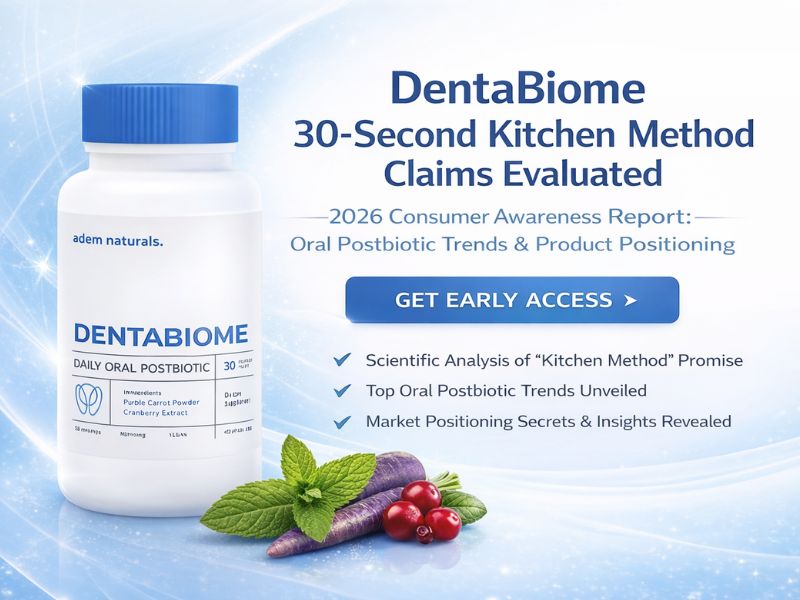
DentaBiome, a chewable tablet supplement built around postbiotic strains and botanical compounds, has become one of the products frequently associated with the phrase "30-second kitchen method" for oral health. With that visibility come real questions. Is the postbiotic approach to oral care grounded in published research? How do DentaBiome's "FabM acid-lock" claims relate to the scientific literature? And what does publicly available research actually say about the individual ingredients involved?
This report covers the DentaBiome formula, its published ingredient research context, pricing structure, and the details consumers should be aware of before making a purchasing decision through the official product page and published terms.
Current product details, pricing, and terms are available by viewing the current DentaBiome offer (official DentaBiome page).
Individual results vary. Dietary supplements are not substitutes for professional dental care, balanced nutrition, or regular oral hygiene. Consult a qualified healthcare provider or dentist before starting any new supplement regimen.
What Is DentaBiome
DentaBiome is a dietary supplement marketed as an oral postbiotic formula delivered through a Berry Frost-flavored chewable tablet. It is positioned as a once-daily chewable designed to deliver postbiotic compounds directly to the oral cavity rather than the digestive tract — which is the basis for the chewable format over a traditional capsule.
DentaBiome is manufactured in the United States in an FDA-registered, GMP-certified facility. Each batch undergoes third-party inspections for purity and potency. The supplement is listed as vegan, dairy-free, non-GMO, and non-habit forming.
DentaBiome is sold directly through the official website at getdentabiome.com. The return address is listed as Adem Naturals, 285 Northeast Ave, Tallmadge, OH 44278. Payments are processed through ClickBank as the authorized retailer.
Each chewable tablet contains a proprietary blend of postbiotic strains and natural compounds. The key strains include Lactobacillus plantarum (dual-strain complex), Lactobacillus salivarius, and Lactobacillus rhamnosus, along with what the formula includes as a "BioFresh Clean Complex" enzyme blend, xylitol, purple carrot powder, and cranberry extract.
The FabM Acid-Lock: How DentaBiome's Central Claim Relates to Published Research
Published research describes FabM in controlled laboratory settings involving genetically engineered bacterial strains. Application of this mechanism to consumer supplements has not been established in clinical trials. The following section provides context on the published research behind the FabM concept and how it relates to DentaBiome's ingredient approach.
DentaBiome's central marketing narrative connects the supplement to a mechanism involving an enzyme called FabM and its role in creating what is described as an "acid-lock" around harmful oral bacteria. The product page references research showing that disabling the FabM gene made harmful bacteria dramatically more vulnerable to destruction.
FabM is a real enzyme studied in published peer-reviewed research. The FabM gene encodes a trans-2, cis-3-decenoyl-ACP isomerase enzyme in Streptococcus mutans, the primary bacterial species linked to dental caries. Published research from the University of Rochester Medical Center, led by Robert G. Quivey Jr. and colleagues, demonstrated that FabM is responsible for producing unsaturated fatty acids in the bacterial membrane that help S. mutans survive acidic environments.
A 2004 study published in the Journal of Bacteriology (Fozo and Quivey, 2004) showed that when researchers genetically deleted the FabM gene from S. mutans, the resulting mutant bacteria became extremely sensitive to low pH conditions. A subsequent 2007 study demonstrated that the FabM-deficient strain exhibited fewer and less severe carious lesions in a rodent model and was poorly transmissible from host to host.
Separately, research described via the University of Rochester has characterized the magnitude of vulnerability — noting that without FabM, S. mutans becomes approximately 10,000 times more susceptible to acid damage. That figure has been referenced in connection with the FabM research program and appears in supplementary commentary from the research team.
These are real findings on a real enzyme — but there are important distinctions worth understanding before connecting that research to any specific consumer product.
The studies above involved genetic deletion of the FabM gene in laboratory settings using engineered bacterial strains. They did not test any dietary supplement, postbiotic compound, or oral health product. The mechanism studied — complete gene knockout — is fundamentally different from consuming a chewable tablet containing postbiotic ingredients. No published research has demonstrated that any dietary supplement, including DentaBiome, can replicate the effects of genetically disabling FabM in live oral bacteria inside a human mouth.
DentaBiome's marketing materials reference the FabM research as context for the product's positioning. However, the connection between published FabM gene-deletion research and the effects of the specific postbiotic strains in this supplement has not been established through independent product-level clinical trials.
Consumers encountering terms such as "DentaBiome FabM," "acid-lock oral health," "DentaBiome oral postbiotic," or similar marketing-related search phrases should understand that marketing claims referencing institutional research describe gene-level laboratory findings, not product-level clinical outcomes verified through independent testing of the finished supplement.
This report does not conclude whether DentaBiome has or lacks utility as an oral health support formula. It focuses on providing context for how the performance-related marketing language relates to the published research landscape.
Postbiotics vs. Probiotics for Oral Health: What the Research Landscape Shows
DentaBiome's formula is built around postbiotics rather than probiotics — and this distinction does have a basis in published scientific literature, though the practical implications for a consumer supplement are worth examining carefully.
Postbiotics are defined by the International Scientific Association for Probiotics and Prebiotics (ISAPP) as non-viable bacterial preparations or their metabolic byproducts that confer health benefits on the host. Unlike probiotics, which are live microorganisms, postbiotics are the compounds that beneficial bacteria produce — including antimicrobial peptides, organic acids, and protective enzymes.
A 2025 systematic review published in Clinical and Experimental Dental Research evaluated the current evidence regarding postbiotics and dental caries prevention. The review concluded that postbiotics offer a promising approach by targeting cariogenic bacteria and modulating the oral microbiome, with advantages over probiotics in terms of stability, safety, and ease of incorporation into oral care products. However, the same review noted significant limitations, including that most evidence comes from in vitro studies that may not capture the full complexity of the oral cavity, short follow-up durations, and variability in strains and formulations studied.
A comprehensive 2023 review published in Frontiers in Cellular and Infection Microbiology similarly acknowledged that while postbiotics show effects comparable to probiotics in addressing pathogens such as S. mutans, more animal studies and human clinical trials are needed to conclusively prove their effectiveness for oral health applications.
The published research supports the concept that postbiotic compounds can influence oral bacteria under controlled conditions. Whether a specific consumer supplement delivers those compounds at concentrations sufficient to produce meaningful effects in the oral cavity is a separate question — one that requires product-level testing rather than extrapolation from strain-level or in vitro research.
DentaBiome Ingredient Profile: What the Product Page Discloses
The following ingredients are included in the DentaBiome formula. Published research referenced in the sections below relates to individual compounds or strains studied under controlled conditions rather than the finished product as formulated.
The DentaBiome product page lists the following ingredient categories:
Dual-Strain L. Plantarum Complex: These two synergistic postbiotic strains are positioned as the core of the DentaBiome formula. The product page describes this complex as targeting the FabM acid-lock mechanism, supporting enamel remineralization, and neutralizing plaque acids. L. plantarum strains have been studied in published research for antimicrobial activity against oral pathogens, though published studies have used specific characterized strains at defined concentrations — details that the DentaBiome label does not individually disclose.
L. Salivarius: Described on the product page as a "construction blocker" postbiotic that shuts down bacterial construction genes and reduces volatile sulfur compounds associated with bad breath. Published research on L. salivarius has examined its potential effects on oral microbial balance, though outcomes depend on strain selection and dosage.
L. Rhamnosus: Positioned in DentaBiome's marketing as a "gum guardian" that inhibits gum disease bacteria and creates a protective tooth shield. A 2023 study published in Frontiers in Bioscience-Landmark examined antimicrobial effects of postbiotic mediators derived from L. rhamnosus GG on S. mutans under laboratory conditions. These findings are strain-specific and laboratory-based.
BioFresh Clean Complex: Described on the DentaBiome website as a revolutionary enzyme blend that shatters the acid-lock barrier. The product page references specific percentage reductions in harmful bacteria at defined timepoints. These figures are presented in marketing materials and do not appear to be sourced from published peer-reviewed clinical trials testing the finished DentaBiome product.
Xylitol: A well-studied sugar alcohol with published research supporting its role in oral health. Multiple peer-reviewed studies have demonstrated that xylitol can reduce S. mutans levels and inhibit acid production. However, effective dosages in published research typically range from 5 to 10 grams daily — spread across multiple exposures. The amount of xylitol in a single DentaBiome tablet is not individually disclosed on the label.
Purple Carrot Powder: A source of anthocyanin antioxidants. Published research on anthocyanins has explored anti-inflammatory and antibacterial properties, though most published evidence involves concentrated extracts tested under laboratory conditions rather than the amounts present in a multi-ingredient chewable supplement.
Cranberry Extract: Cranberry-derived compounds — particularly proanthocyanidins — have been studied for their ability to interfere with bacterial adhesion. Published research has examined cranberry extract's effects on oral biofilm formation, though effective concentrations and delivery methods vary across studies.
A recurring consideration in this category is whether a product publishes a fully detailed Supplement Facts panel with individually disclosed ingredient amounts. In DentaBiome's case, the product materials do not appear to provide individual dosages for each ingredient. Without that level of disclosure, consumers and healthcare providers cannot directly compare what the product delivers against the specific amounts used in published research studies.
How Proprietary Formulations Affect Research Comparison
When a supplement uses a proprietary blend or does not individually disclose dosages, it allows the manufacturer to list which ingredients are included without revealing exact amounts for each one. This protects formulation trade secrets but limits a consumer's ability to evaluate whether individual ingredients are present at research-supported levels.
For context, published xylitol research for oral health effects typically uses 5-10 grams daily. Published L. rhamnosus studies have used defined colony-forming units at specific concentrations. Cranberry proanthocyanidin research typically specifies the concentration of active compounds.
Without individually disclosed dosages on the label, there is no way to confirm or rule out research-level dosing from the product information alone. This is not unique to DentaBiome — many supplements use similar structures. But understanding how they work helps set realistic expectations when marketing materials reference published studies conducted at specific, known dosages or concentrations.
The "30-Second Kitchen Method": What This Marketing Phrase Refers To
DentaBiome's marketing frequently uses the phrase "30-second kitchen method" to describe the product's use case. In practical terms, this refers to chewing the Berry Frost-flavored tablet once daily — a process that takes approximately 30 seconds.
The "kitchen method" framing is a consumer-facing marketing phrase designed to position the supplement as a simple daily habit rather than a complex regimen. The rationale for the chewable format — rather than a traditional capsule — is that chewing releases the postbiotic compounds directly into the oral cavity where they can contact tooth surfaces, gum lines, and other areas where harmful bacteria reside, rather than being dissolved in the stomach.
The concept of oral delivery for oral health ingredients has scientific merit. Research on oral probiotics and postbiotics has generally supported the idea that direct oral exposure may be preferable for targeting the oral microbiome compared to gastrointestinal delivery. However, no published clinical trial has tested DentaBiome's specific chewable format against a capsule version to confirm a meaningful difference in oral health outcomes.
How Clinical Evidence for Supplement Effectiveness Is Typically Established
A recurring issue in supplement-category research is what level of evidence has been established for a finished product, and that question applies broadly across this category, not just to DentaBiome.
For a dietary supplement to demonstrate effectiveness through clinical evidence, the standard generally includes a randomized, placebo-controlled trial using the finished product at its actual dosage. The study would need to disclose the exact formulation, specify the duration of use, define measurable endpoints such as changes in oral bacteria counts, gum health indices, or cavity incidence, and enroll a study population representative of the target consumer.
Results would typically be published in a peer-reviewed journal and subject to independent scrutiny. Ideally, a second independent study would replicate the findings to strengthen confidence in the conclusions.
As of this writing, no published clinical trial appears to have evaluated DentaBiome as a finished proprietary formula using this standard. The research cited on the product website pertains to individual strains or compounds tested in isolation or under laboratory conditions, often at dosages or concentrations that may differ from what the product delivers. That is common across the supplement industry, but it means the gap between ingredient-level research and product-level proof remains open.
Understanding this distinction is not about dismissing any product. It is about knowing exactly what has and has not been demonstrated so consumers can interpret the available evidence landscape rather than relying solely on how marketing materials frame it.
DentaBiome Pricing and Purchase Structure
DentaBiome is presented in multi-bottle packages through the official website:
The 6-bottle option (180-day supply) is listed at $49 per bottle ($294 total), includes two free bonus digital guides and free US shipping. This is described as the most popular option.
The 3-bottle option (90-day supply) is listed at $69 per bottle ($207 total) and includes the two free bonus guides.
The 2-bottle option (60-day supply) is listed at $79 per bottle ($158 total).
All purchases are one-time payments with no auto-ship, subscriptions, or hidden charges. The bonus guides included with multi-bottle packages are supplementary oral health resources covering at-home oral care techniques.
Pricing and availability can change, so consumers should verify current terms by viewing the current DentaBiome offer (official DentaBiome page).
DentaBiome Refund Policy and 60-Day Guarantee
DentaBiome orders are covered by a 60-day money-back guarantee. Consumers who are unsatisfied within the first 60 days of purchase can request a full refund by contacting the support team.
Bottles — even empty ones — should be returned to the Tallmadge, Ohio address. After processing a refund request, confirmation is sent via email. Refund timelines depend on the buyer's payment method and financial institution.
Refund requests may be initiated through ClickBank's self-service portal or through DentaBiome's support email at support@getdentabiome.com.
DentaBiome Testimonials: What Consumers Should Know
The official website includes customer testimonials describing outcomes such as changes in gum bleeding, breath freshness, cavity occurrence, and gum pain. These testimonials are attributed to named individuals and labeled as "Verified Purchase." Testimonials reflect individual experiences and are not considered clinical evidence.
The DentaBiome Terms and Conditions page includes a testimonial disclosure that provides additional context. The terms state that testimonials are individual experiences, that results vary, and that testimonials are not necessarily representative of all users. The terms further state that images or names used may have been changed to protect privacy.
The Terms also explicitly state that testimonials are not intended to make claims that these products can be used to diagnose, treat, cure, mitigate or prevent any disease, and that claims have not been clinically proven or evaluated by the FDA.
Even where testimonials reference specific health improvements, the published terms state these are individual experiences and not representative of typical outcomes. Consumers should factor these disclosures into how they interpret testimonial-based content on the product website.
Common Research Considerations in the Oral Supplement Category
Individually disclosed ingredient dosages. Individually disclosed ingredient dosages are one of the recurring research considerations in this category. When exact amounts are not disclosed on public-facing materials, consumers may seek clarification from the manufacturer through the published contact channels.
Ingredient research vs. product research. Published studies on individual postbiotic strains, xylitol, and cranberry extract were conducted under specific laboratory or clinical conditions. Consumers researching this category frequently encounter ingredient-level findings referenced in product marketing — understanding that these studies did not test the finished proprietary formula helps set realistic expectations.
FabM research context. FabM gene deletion research involved genetic engineering of bacteria in laboratory settings. Consumers researching this mechanism often encounter the 10,000x vulnerability figure, which refers to outcomes from gene knockout studies — not from testing any dietary supplement in a human oral environment.
Testimonial disclosures in the terms of service. The fine print on many supplement websites contains information about whether results are typical and whether names or images may have been changed in marketing materials. These disclosures are part of the background information consumers may encounter when reviewing supplement marketing materials.
Refund terms and guarantee conditions. Guarantee terms, return requirements, and processing timelines are part of the publicly available purchase and return information associated with the product.
Professional dental or medical input. Adults managing active periodontal disease, taking prescription medications, or undergoing dental treatment commonly consult a healthcare provider before adding any oral supplement to their routine.
How DentaBiome Is Positioned Within the Oral Supplement Category in 2026
DentaBiome is marketed toward adults exploring postbiotic-based oral health support as one component of a broader routine that may also include regular brushing, flossing, and professional dental care. Consumers conducting their own category research can review current product details by viewing the current DentaBiome offer (official DentaBiome page).
Consumers prioritizing fully disclosed ingredient amounts for research comparison, treatment for active dental disease, or products intended to replace professional dental care may interpret the product differently depending on their individual needs and expectations.
As with any dietary supplement, individual outcomes depend on a wide range of personal health factors. Supplements are regulated differently from pharmaceutical drugs, and the FDA does not evaluate dietary supplement claims for efficacy before products reach the market. The standard FDA disclaimer that applies to all dietary supplements confirms that the product's statements have not been evaluated by the Food and Drug Administration and that the product is not intended to diagnose, treat, cure, or prevent any disease.
Consumer Questions About DentaBiome
What is the "30-second kitchen method"?
The "30-second kitchen method" is a consumer-facing marketing phrase used on the DentaBiome website. It refers to chewing one DentaBiome tablet daily — a process that takes approximately 30 seconds. The phrase itself is not a recognized dental protocol or scientific method.
Is DentaBiome FDA approved?
DentaBiome is a dietary supplement. Under current federal regulations, dietary supplements do not require FDA approval before being sold. The FDA does not evaluate supplement efficacy claims. DentaBiome is manufactured in an FDA-registered, GMP-certified facility, which relates to manufacturing standards rather than product approval.
What is the FabM acid-lock?
As used in DentaBiome's marketing, the "FabM acid-lock" describes a proposed mechanism where the FabM enzyme creates a protective shield around harmful oral bacteria, allowing them to survive despite brushing, flossing, and mouthwash. FabM is a real enzyme studied in published research at the University of Rochester, and its role in S. mutans acid tolerance has been demonstrated in laboratory settings. However, the specific framing as an "acid-lock" that a supplement can "break" is marketing language rather than a term used in published scientific literature.
What are postbiotics, and how are they different from probiotics?
Postbiotics are non-living compounds derived from beneficial bacteria — including antimicrobial peptides, enzymes, and organic acids. Unlike probiotics, which are live microorganisms, postbiotics are already produced and fully stable. Published research has explored postbiotic applications for oral health with promising early results, though most evidence comes from laboratory studies rather than large-scale human clinical trials.
Can I verify the research DentaBiome references?
The official website lists scientific references at the bottom of the sales page, including citations from PubMed and other research repositories. These citations point to published studies on oral microbiome research, postbiotic effects on dental caries, and enzymatic treatment of biofilms. These studies can be looked up through PubMed or the relevant journal archives. The referenced studies examined specific strains, compounds, or mechanisms under controlled research conditions — not DentaBiome's proprietary formula as a finished product.
How long does DentaBiome take to show results?
The DentaBiome FAQ suggests using the product for at least 3 to 6 months as part of its marketed usage timeframe. The Terms and Conditions clarify that testimonial results are individual experiences and not representative of typical outcomes. Individual timelines depend on factors including baseline oral health, dietary habits, and consistency of use.
Is DentaBiome safe?
DentaBiome contains postbiotic compounds rather than live bacteria, which is presented as a distinguishing feature of the formulation. The product is described as vegan, gluten-free, soy-free, non-GMO, and free from major allergens. However, individual reactions to any supplement can vary. Consumers with existing health conditions, allergies, or those taking medications should consult a healthcare provider before use.
What is the DentaBiome refund process?
The published policy provides a 60-day window for refund requests. Refunds can be initiated through DentaBiome's support email (support@getdentabiome.com) or by calling 1 (814) 885-4823 (Monday through Friday). Returns should be sent to Adem Naturals, 285 Northeast Ave, Tallmadge, OH 44278. Refunds can also be initiated through ClickBank's self-service portal.
Where is DentaBiome sold?
DentaBiome is available through the official website at getdentabiome.com. Purchases are processed through ClickBank. Free US shipping is included with the 6-bottle package, with international shipping available to select countries for an additional fee.
Contact Information
Company: DentaBiome (Adem Naturals)
Return Address: 285 Northeast Ave, Tallmadge, OH 44278
Email: support@getdentabiome.com
Phone: 1 (814) 885-4823 (Monday through Friday)
Payment Processor: ClickBank (Click Sales Inc.)
Self-Service Billing Support: www.clickbank.com/corp/support/
For questions about the product, ordering process, or shipping, DentaBiome's support team can be reached through any of the channels listed above. Complete product details, current pricing, and published terms are available by viewing the current DentaBiome offer (official DentaBiome page).
Disclaimers
Content and Consumer Information Disclaimer: This article is an informational overview and does not constitute medical, health, dental, or dietary advice. All product details, ingredient information, pricing, and policy terms described in this article are based on publicly available information from the official DentaBiome website and product labeling. Readers are encouraged to verify all details directly and to consult a qualified healthcare professional or dentist before beginning any dietary supplement.
FDA Health Disclaimer: These statements have not been evaluated by the Food and Drug Administration. This product is not intended to diagnose, treat, cure, or prevent any disease. Always consult your physician or dentist before starting any new supplement, especially if you have existing health conditions, take medications, or are pregnant or nursing.
Professional Medical and Dental Disclaimer: This article is educational and does not constitute medical or dental advice. DentaBiome is a dietary supplement, not a medication or dental treatment. If you are currently taking medications, have existing health conditions, are pregnant or nursing, or are undergoing dental treatment, consult your physician or dentist before starting DentaBiome or any new supplement. Do not change, adjust, or discontinue any medications or prescribed treatments without your healthcare provider's guidance and approval.
Results May Vary: Individual results will vary based on factors including age, baseline oral health condition, dietary habits, oral hygiene practices, consistency of use, genetic factors, current medications, and other individual variables. While some customers report improvements, results are not guaranteed. People who write reviews are self-selected — satisfied customers are more likely to post feedback than those with neutral or negative experiences.
FTC Affiliate Disclosure: This article contains affiliate links. If a product is purchased through these links, a commission may be earned at no additional cost to the buyer. ClickBank serves as the authorized payment processor for this product. ClickBank's role as retailer does not constitute an endorsement, approval, or review of this product or any claim, statement, or opinion used in its promotion. This compensation does not influence the accuracy, neutrality, or integrity of the information presented.
Pricing Disclaimer: All prices, discounts, and promotional offers mentioned were accurate at the time of publication (March 2026) but are subject to change without notice. Always verify current pricing and terms on the official DentaBiome website before making a purchase.
Publisher Responsibility: Every effort has been made to ensure accuracy at the time of publication. Readers are encouraged to verify all details directly with DentaBiome and their healthcare provider before making decisions.

Email: support@getdentabiome.com Phone: 1 (814) 885-4823 (Monday through Friday)

Legal Disclaimer:
EIN Presswire provides this news content "as is" without warranty of any kind. We do not accept any responsibility or liability for the accuracy, content, images, videos, licenses, completeness, legality, or reliability of the information contained in this article. If you have any complaints or copyright issues related to this article, kindly contact the author above.
